Build Design Systems With Penpot Components
Jul 21, 2:15 AM
Penpot's new component system for building scalable design systems, emphasizing designer-developer collaboration.
smashingmagazine.com
medium bookmark / Raindrop.io |
Improv is a form of live comedy in which the plot, characters and dialogue of a game, scene or story are made up in the moment.
 <img class=”progressiveMedia-noscript js-progressiveMedia-inner” src=”https://cdn-images-1.medium.com/max/1600/1*-zddUgT0X6nUtZ3zlF4fjQ.png”>
Credit: Bitmoji + Unsplash
I moved to Toronto to start working at Playground Inc. I arrived alone, I didn’t know anybody and was struggling to be my natural self in my new environment. I needed a way to help me break out of my shell and express myself freely. So I started doing improv. I’ve never acted in my life and I’m terrified of public speaking. But the idea of making people laugh and acting on the spot appealed to me. Without knowing too much more I started my journey.
I showed up to my first drop-in class. After a few warm-up exercises and getting to know each other, the instructor collected names of those who wanted to participate in stage games. I wasn’t entirely sure what the “stage games” were but I put my name forward anyway.
My name was pulled out from the hat. I raced onto the stage with two fellow improvisors and there I was about to play my first improv game in front of a crowd of 30+ people. We were given a scene and assigned a character each. The scene was a coffee shop and I was a Power Puff girl alongside Yoda and Inspector Gadget. The instructor yelled “Act out a scene”.
Oh shit, where do I start.
I just started fluttering around the stage talking like a girl — then I slipped and fell off the stage!
I slipped and fell off the stage!
The instructor stopped the scene and reminded everyone not to get too close to the edge of the stage, using me as an example. I felt like a complete moron and the obvious reminder added to the embarrassment.
I spoke to as many people afterwards to try laugh it off. It definitely wasn’t my proudest moment but people applauded me for brushing it off and carrying on. If anything it makes for a funny story now!
Tip: It’s ok to suck at something you can only get better!
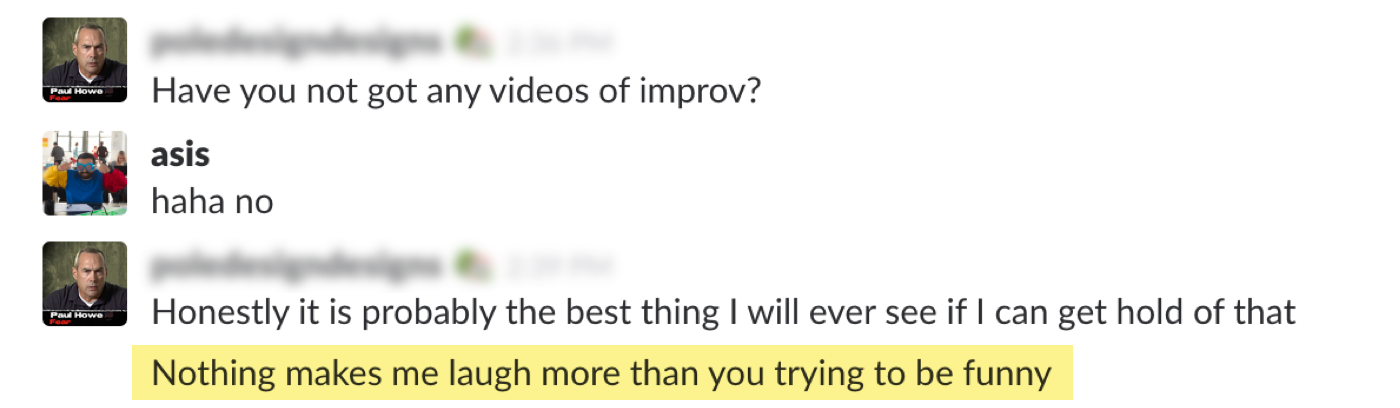
When I told my friends I’ve started doing improv I was welcomed with laughter and not the kind I was after, it was more along the lines of “That sounds weird, what the hell are you doing!?!”
 <img class=”progressiveMedia-noscript js-progressiveMedia-inner” src=”https://cdn-images-1.medium.com/max/1600/1*wYaqZ5rgAMa0AYVK_R7tIg.png”>
I have great mates…
I just laughed off negative reactions and did it anyway…
My friends laughed at me, I sucked at it, but I enjoyed it so I kept doing it. I find enjoyment in making people laugh and improv was a great way to practice being funny on the spot.
I saw Second City had a 7 weeks introduction to improv course. It sounded like a perfect way to learn more about improv so I signed up! Once a week for 7 weeks I went to class to play group games and exercises, learning to work with others, start to trust myself and not be afraid to fail.
Tip: Keep doing things that makes you happy and try get better at them
The improv course was a great way to spend time with like minded people and share a journey.
I wanted to use improv to start tackling some of my deeper insecurities. I find I worry too much about making mistakes, I get so nervous when speaking in groups of people and have the false belief that what I have to say isn’t important. Overall I wanted to become more comfortable expressing myself without the fear of being judged.
Exchanging stories and reasons for doing improv with the rest of the group was a great way to hear other perspectives. I learnt that I wasn’t alone with my insecurities and other people were there for similar reasons too.
Tip: Sharing honest thoughts lets you connect deeper with others
The #1 rule of improv is to say yes and…
Everyone wants to feel valued. Improv encourages you to accept everything – dialogue, gestures, props — and build upon it. Agreement allows the scene or game to progress.
This is true in everyday life too. At work we often have client workshops where we come together as a team and brainstorm ideas for new products. I’ve learnt to never shoot down any ideas and just suggest how they could be improved. Instead of saying “that idea won’t work”, I say “to build on that I would…”. It’s important to keep the conversation moving forward and make everyone feel valued.
Tip: Don’t say why it’s bad, just show how it could be better
Life teaches you to do things in a certain way, have a set structure, follow a path. Improv says screw that! Instead it trains you to rip up the script and be open enough to react to whatever happens in the moment!
Forward planning doesn’t account for what could happen. For example I’m planning a scene in my head about doing a science experiment in a school classroom, but my stage partner turns to me and says something about mowing the lawn. This completely changes the script and all that I had planned goes out of the window – the narrative has completely changed.
Don’t have a rigid plan, trust yourself to react to whatever may happens next.
Tip: you can’t plan for everything, so don’t try
I worry so much about being wrong, sounding stupid or not having a valid opinion.
Improv teaches you that there is no wrong answer, instead just keep doing even if you feel like you are wrong. Just keep putting your ideas out there, something you think isn’t good might be useful to someone else.
Becoming comfortable being uncomfortable is important, learning to put your best foot forward and run with whatever happens. Improv helped me realise that no one is angry if you mess up! Life is full of mistakes and people are often worried about their own mistake to worry about yours.
Honesty is the real funny. You don’t need to force yourself to be funny, just be yourself and let your humorous side naturally come out. Comedy lies in the little things we do everyday which we don’t notice or talk about.
Tip: just keep doing and don’t worry about the outcomes
What you have to say is important, so say it and say it with conviction. Improv helped me get my point of view across clearly by practicing saying things with confidence and assertion.
Like the time I started a scene by angrily saying “I asked you to get Bacon!!”. Now we have a clear opening to a scene about a guy who really wants bacon. The audience were on board and my stage partner had a clear offer they could use.
Speak up and speak with conviction even if you might be wrong, it let’s people know what you think! Lead with a strong point of view to make your perspective clear. Being unsure or on the fence about something doesn’t make for good entertainment and it also makes it hard for your fellow improvisers to latch onto and make a scene with you.
Tip: have an opinion and don’t worry about being ‘wrong’
When having a conversation who’s leading? How do you switch the lead? How do you add to the conversation? Where do you look and how do you act? These are all questions we unconsciously answer in our daily lives.
Improv teaches you to become more conscious of these questions.
Let’s say you are performing a scene with two other people. It’s all about mastering the art of knowing when to jump in and when not too. It requires you to listen and observe your surroundings before acting — This of course takes practice but to keep the energy flowing it’s important to say something that adds to the scene and doesn’t ruin the flow.
Even though you don’t want to ruin the rhythm, you also don’t want to overthink and not jump in at all – if you do throw a curveball into the conversation remember to steer it to keep the energy flowing till the next person picks it up, don’t just drop it and run.
I notice when I’m nervous I just jump into scenes and over complicate things. Like the time I burst into a dance routine and the scene was three of us waiting at a bus stop, everyone else was thinking what the hell is going on so I stopped dancing which made the scene awkward! In hindsight if I had kept dancing and everyone else joined in, it would have been a hilarious scene!
The trick is not to overthink things and keep actions simple, but if you do throw something out there run with it until the next person picks it up. Make sure there is no dead air.
Tip: Inhale before exhaling
No emotion is boring and so is too many words. Improv teaches you to use more emotion and less words. Every time I spoke with exaggerated emotion the group would perk up, like the time I yelled with passion “l love chicken wings especially when the sauce is all over my beard”, it sounds weird I know, but the emotion made it compelling and made the audience laugh.
A great game we played was acting out scenes talking only in gibberish. Our partners had to guess what the scene was about. The only way to communicate the scene was to really exaggerate our emotions, show when we are happy, sad, scared. The trick is to keep things simple and really emphasis the emotion. Focus on getting the big strokes across not the small details. I acted out a scene about smashing a window playing golf in a field as a kid and getting told off by my parents. I focused on the details like pick up my golf clubs, walking to the field, which made it hard for my partner to guess what was going on. Had I of focused on the big strokes like smashing a window or being told off by my parents it may have been easier for my partner to understand.
Bold emotions and obvious references work best! Just keep things simple.
Tip: Cutout the extra words and replace with emotion
 <img class=”progressiveMedia-noscript js-progressiveMedia-inner” src=”https://cdn-images-1.medium.com/max/1600/1*VEC5JyJ8KpwLA8CH7doc0g.png”>
Good job fellow improvisors!
Diving into improv has been amazing. It’s helped me not worry as much and become more comfortable putting myself out there. I’ve discovered I love making people laugh and telling stories. I just need to keep finding ways to get better at that, keep putting myself out there and see where the journey takes me.
Life is filled with unexpected twists and turns. Don’t live by a script just keep improvising
Hope you enjoyed it! Give me a few 👏🏼 👏🏾 👏🏿 if you’re feeling generous
AI-driven updates, curated by humans and hand-edited for the Prototypr community