1) Understand current motivations and expectations
While this may seem like they typical run-of-the-mill “understand your customer experience,” it’s a bit more complicated than that. Understanding who your customers are and what your customers are doing on their journey is one thing, but digging into their routine — what drives people to repeat behaviours — is where the insight comes in.
We often ask our Z customers why they choose to pay inside over pay at the pump, and we get a slew of answers — “I like to talk to the people inside,” “I think it’s easier,” “I want a drink” — but those answers are typically just the surface answers, not digging into the real meat. I believe many customers have formed routines over time, such as going to the same fuel stations (even favouriting specific lanes!), talking to the same people, and using the same form of payment. The idea of changing those behaviours, no matter how much better or easier things will become, doesn’t compete with the ease and comfort of routines.
“We can design for the fact that our users carry a consistent set of expectations about how the world works.”—Emmet Connolly, Director of Product Design at Intercom
We also know that people see and expect the world to work in a certain way and showing them a different reality should be done with special intent and thought, especially when we’re asking them to change their behaviour to something less compelling.
Maintaining a sense of user autonomy is a requirement for repeat engagement. Fuel, for example, is an energy commodity that people feel some ownership over. They invest in a vehicle and expect to use it easily and in the same way they have been for the past 100 years (while ideally keeping costs as low as possible). Changing people’s expectations that this is not a commodity they have ownership of but rather a service and a resource they are paying for is threatening their known reality and autonomy. Customers could even rebel against this new behaviour. Psychologists refer to this as reactance.
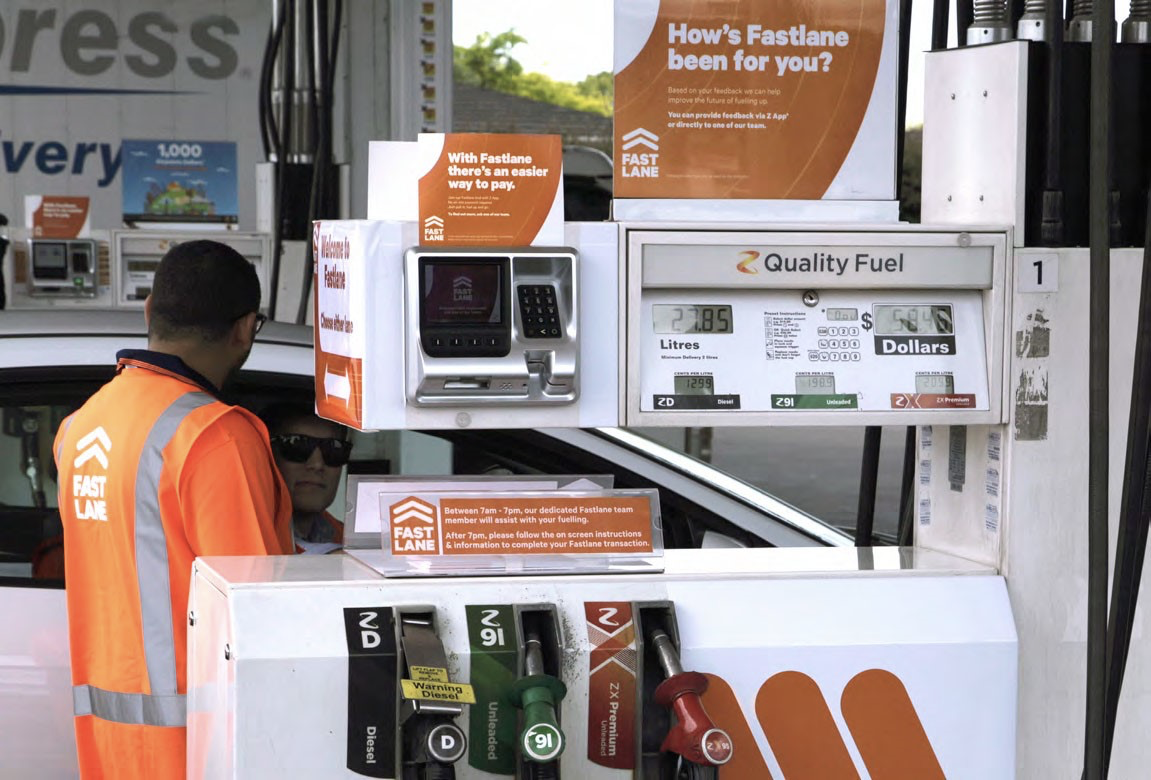
As expected, our Fastlane trial so far has seen a direct impact of going against people’s expectations and is gathering reactances. Because there are specific lanes just for registered users, if someone pulls up who is not registered, the driver is asked to move to a different lane. It’s a simple request but because of people’s routines and expectations, a few have become defensive. We never expected the amount of strife Fastlane has created, but it has been great for teaching us about the difficulty of changing behaviours.
On the flip side, for those who are registered and arrive to a Fastlane, the drivers’ name flashes on the pump screen. While the primary purpose of this is to notify our concierge, it also gives the driver personal recognition and the expectation that this is their lane and the pump is ready for their use. It’s small details like these that could ease customers into new and different ways of doing things as we slowly start changing expectations and the experience.
Understanding who our customers are, what and how they interact with the product, and the why of their behaviours is necessary to inspire change.
2) Offer the right triggers at the right time
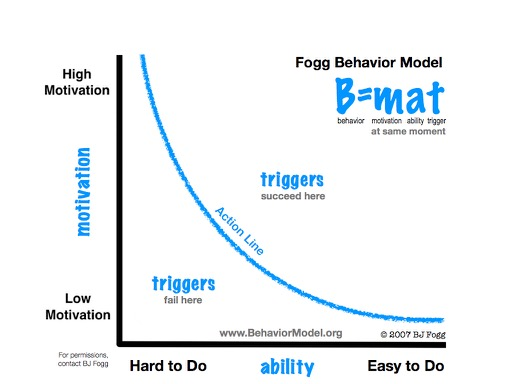
We’ve discussed above that an individual’s current behaviours and expectations might inhibit their motivation and ability to change, but more times than not, we aren’t offering the right triggers at the right time.
There are two types of triggers, according to Nir Eyal: external and internal. An external trigger is typically some piece of marketing or cue to remind someone to do a particular action. These are seen as emails, push notifications, signs, etc. Unfortunately, external triggers often don’t work unless it can be connected with an internal trigger. (For example: I get a notification from Facebook on my phone, I realise that I’m bored, so I open Facebook; I see the powerful McDonald’s Golden Arches, I realise I’m hungry, so I pull into a McDonald’s). Leveraging these internal triggers in association with external triggers can be very powerful, as long as one’s individual ability isn’t inhibited. To create new customers, great marketing campaigns will often focus on the feeling experienced when someone purchases a product, so that the potential internal trigger can be associated with the external trigger in the wild.
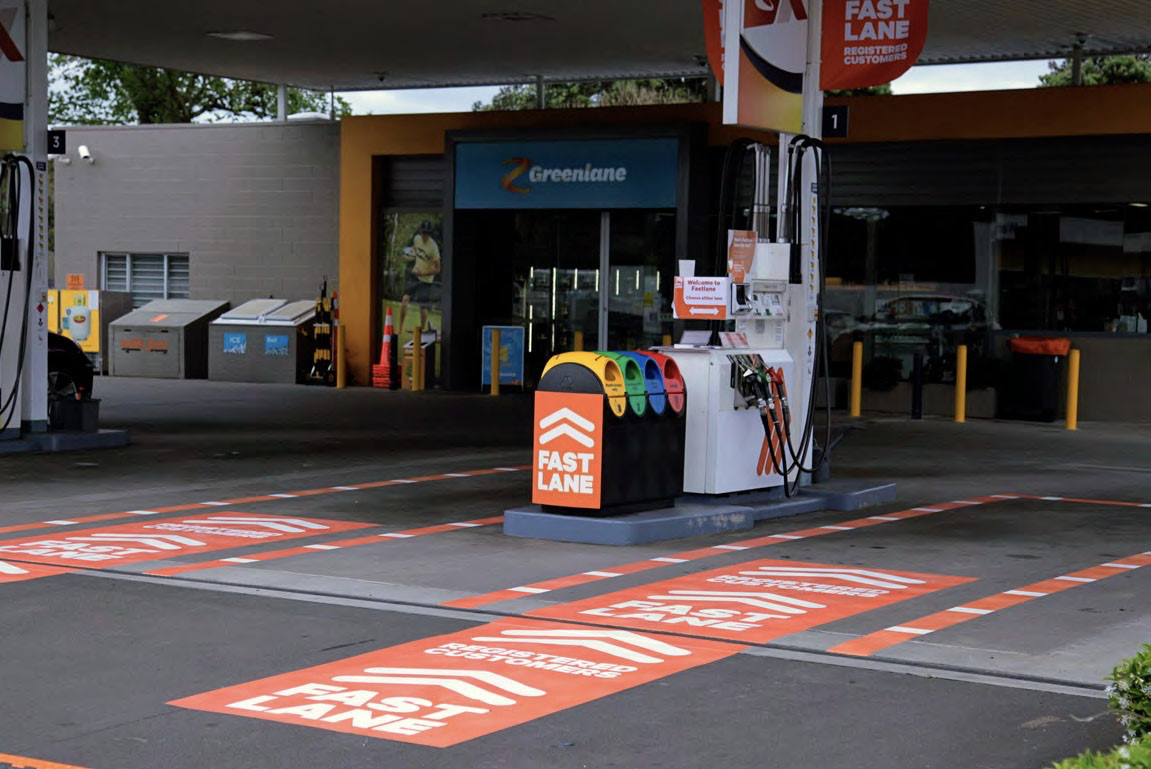
For our Fastlane trial, we heavily relied on external triggers at particular Z Stations because it was a limited release. We asked people to download the app and register through brochures and posters. We created big, bright orange floor signage to trigger customers into driving into that particular lane. Stickers and flags were plastered all over the pumps. While these are all great external triggers, Fastlane won’t create an emotional connection with our customers until they try it and, as with most services, customers need to register. Unfortunately, downloading an app and registering when you are on the forecourt of a petrol station certainly doesn’t align with existing customer habits in this setting. Breaking down these barriers of registration (Fogg’s ‘ability’) is necessary for us to move forward and break the power of habit:
- Don’t want to use their cell data to download an app
- On the go and busy, can’t be bothered (or they’re driving)
- Regulation enforces not to use phones on the forecourt
- Lack of understanding of their smartphone (or don’t own one outright)
Experimenting with various external triggers—such as free WIFI at the petrol station or an offline registration process—will be helpful so that we can start learning if there are repeat visits, indicating that people have made a positive emotional connection with the faster payment system.
“If a user is presented with a call to action when they’re able and somewhat motivated to perform a behaviour, it’s likely that they will. If they then have a good experience… they will be reinforced to use it again in the future. If the following occurs enough times, a habit will be formed.” — Jason Hreha, Head of Product, Behavioural Sciences at Walmart.
3) Build new habits by experimenting with rewards
It’s easy to think about rewards as something tangible that we can offer our customers, but to build new habits, we need to focus on deeper, intrinsic rewards. Duhigg says: “Rewards are powerful because they satisfying cravings. But we’re often not conscious of the cravings that drive our behaviours.”
These cravings are woven together through motivations, rewards, action, and investment—otherwise known as the Hook Model.
An in-depth 13-minute recap of Nir Eyal’s influential book about building habit-forming products.
At the heart of the Hook Model is a powerful cognitive quirk described by B.F. Skinner in the 1950s, called a variable schedule of rewards. Skinner observed that lab mice responded most voraciously to random rewards. The mice would press a lever and sometimes they’d get a small treat, other times a large treat, and other times nothing at all. Unlike the mice that received the same treat every time, the mice that received variable rewards seemed to press the lever compulsively
Nir Eyal says that there are three types of variable rewards and that must satisfy the needs of the customers while driving motivation to reengage again. These three are:
- Rewards of the tribe are social rewards fueled by connectedness with other people.
- Rewards of the hunt is the search for material resources and information.
- Rewards of the self is the search for intrinsic rewards of mastery, competence, and completion.
(Similarly, Hreha says that one way to amplify motivation are through incentives, which he broke into four categories—monetary, tangible item, point-based, social.)
Furthermore, understanding the core-users and what they value with a product, will take some experimentation. It’s important to test different rewards and learn which rewards will drive change.
“This might take a few days, or a week, or longer. During that period, you shouldn’t feel any pressure to make a real change — think of yourself as a scientist in the data collection stage.” —Charles Duhigg
While Fastlane hypothetically eases the pain of payment, we need to learn through our trial if the intrinsic reward triggers reengagement in the future. Furthermore, we need to learn if people are willing to sacrifice other rewards they are getting in a normal fill-up to satisfy their need to just fill-up and go. Experimenting with different incentives for sign-up, different rewards for fill-up, and variable rewards for loyal customers will be great for our team to try break some of the barriers mentioned above.