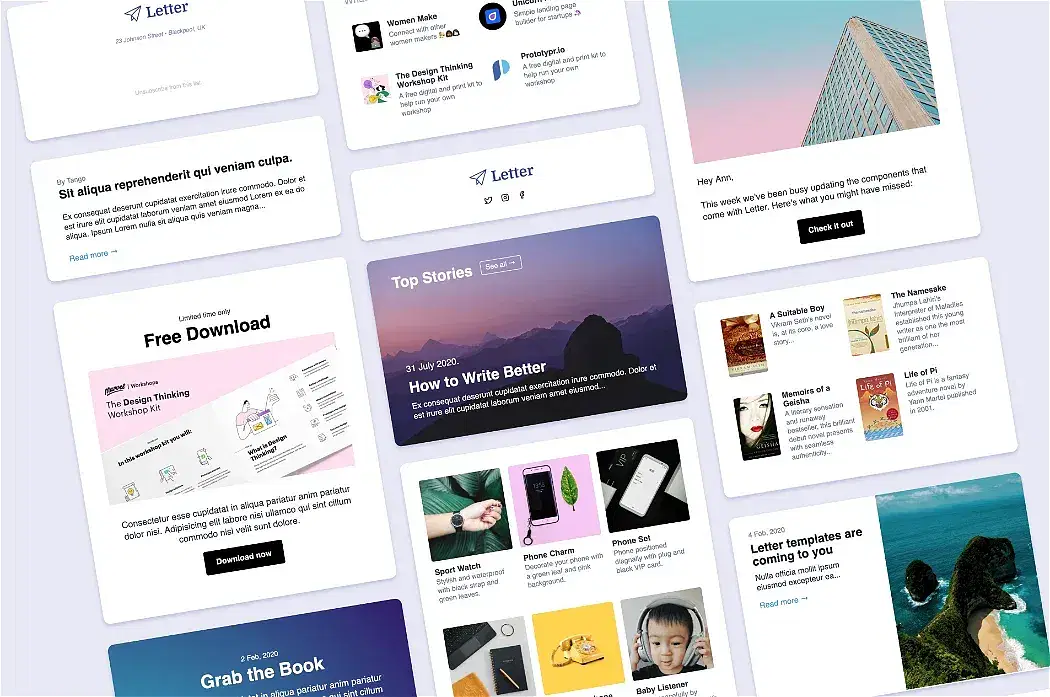
Build Design Systems With Penpot Components
Jul 21, 2:15 AM
Penpot's new component system for building scalable design systems, emphasizing designer-developer collaboration.
smashingmagazine.com
medium bookmark / Raindrop.io |

UX @ Booking.com / Product Designer & Thinker / @jamesbtlr

At Booking.com, we’ve put a lot of work into improving how guests and properties communicate through our products. Guests have been able to directly contact a few select properties through our platform for some time. But with over a million property partners on our platform, a select few was not enough for us.
So over the past year, we’ve been working on pilot version of a new chatbot — something we call the Booking Assistant — to allow our customers to get fast and relevant answers to any questions they have about their bookings.
Guests can still directly message properties. But now instead of sending properties every message, for a small group of English-language bookings participating in the pilot, the bot can simply look up information we have stored and respond instantly. We only send properties the questions we can’t answer for them. This leaves our partners to handle real guest issues, whilst we take care of the rest.
Below are 7 things we’ve learned so far designing the Booking Assistant.
When I started working on this project, conversational design was completely new to me. Heading straight into pixels is easy. But when designing a chatbot, words are more impactful. And perhaps, most importantly, a conversation should feel natural to the user.
Because people think and express themselves differently, you need to see each conversation in context. Where does the conversation start? How should it end?
At Booking.com, our users could be doing any number of things before entering a conversation with the Booking Assistant. We had to make sure that each entry point had a natural beginning. Try to deduce user intent from what users are doing at the time. Focus entry points around relevant actions in that context.
Once inside your chatbot, elements such as message bubbles and cards can help guide conversation. But the real super power is the language you use. The bot can help the user to interact with the right thing at the right time.
Spend some time thinking about how people move through the conversation. Think about where and how you can use words — instead of UI elements — to deliver a great experience. If you can get the conversation right, you can design experiences that are natural to use.
Early on in our process, we were designing conversational flows in Google Docs. This was fine for our early prototypes but was never going to scale.
To combat that issue we started to think about how our conversational flows would work for other teams. If someone else wanted to create something on our platform, how could we let them do it?
We moved away from Google Docs and began working on a set of internal tools to make this process much easier. Now, not only are we able to have an overview of each conversational flow, any team that wants to write their own flow for our chatbot will be able to work with our tooling to do so.
Without thinking about how to scale, we would have been lost in a sea of Google Docs. Thinking beyond our own scope allowed us to avoid a potentially messy situation and create new opportunities for others to use our platform.
Make sure that you don’t only build for now, but for the future. Think about who else might use your product and how you can make that happen.

The clear benefit of chatbots is that there are no new applications to install. Most users already have messaging apps and are familiar with using them. Alongside that, companies like Facebook have taken major steps in bringing bots to the public.
But, from our first user research session, it was clear that the Booking Assistant was not going to be for everyone. Some users came in and flew through our prototypes — and we spent less time testing the prototype itself and more time asking questions to understand why it was so easy for them. Others came in and were confused and angry about using a chatbot. They found the technology alien to them and just wanted to speak to a human.
One of our greatest moments was when we converted a man from a sceptic to a believer. He entered the room hating the idea. He left calling the Booking Assistant “his new friend”. 🙌🏻
Either way, it was clear that this type of technology isn’t for everyone yet. And that’s ok. Focus on making the experience great for your early adopters and provide alternative channels for those who need help in a different way.
At first, we were unsure if our chatbot should have a personality or not. In fact, we were unsure if we should even call it a bot. Would people even understand what a bot was?
We had many discussions about it within our teams, but it was through user research we discovered that it didn’t matter what we thought. Every person that came into our user testing lab assumed a personality or gender for the bot. Even if we hadn’t designed one.
Obviously, that wasn’t going to work. So to have more control over the experience, we decided it was better that we give the bot a personality, rather than letting each user imagine one. We still let our users assume a gender if they want to. But the personality is something we will continue to work on over time.
Figure out what kind of personality you want your bot to have. Is it friendly? To the point? Does it use emojis? Can it tell a joke? Should it tell a joke? All things can be considered at this stage. Form a close relationship with your copywriter — you’ll need it!
Whilst Artificial Intelligence (AI) is still in its infancy chatbots will undoubtedly have problems. Real people can help you through this and delight your customers at the same time.
Having real people involved means that, for now, we can automate the easy questions our bot receives. This allows our customers to get the answers they need quicker than ever before. But if we’re unsure about an answer, we’ll hand the message over and a real human will then respond.
We launched the pilot version of the Booking Assistant with a small team of 10 Customer Service agents here in Amsterdam. Those agents helped to categorise each incoming message. In doing this, we could quickly train our bot to understand the content of messages we were receiving. At the same time, our agents were able to give personal and fast responses to questions from our guests that our bot couldn’t handle this early on.
At the same time, if any questions we receive are more relevant for a hotel or apartment owner to answer, we pass the message along to them.
If you want your customers to have a great experience, provide some kind of fallback or escape route. Don’t let them get stuck in an endless loop of bot messages with no way out.

Our Pulse app for partners allows fast responses to guest messages
For most consumers, the most important aspect of contacting a business is being available 24/7. And the standard 9–5 definitely goes out the window when you launch a chatbot.
We learned this during our early user testing when our pilot team of customer service agents left for the weekend. They returned on Monday morning to a bunch of messages — from Booking employees testing the product — sat in their inbox needing a response. Not something we wanted to happen in the real world, for sure!
In a world where people want everything on demand, messaging can’t become a voicemail-like service. If you want to deliver a great experience you need to always be available. Through a chatbot, customers should be able to get their most basic questions answered in a few seconds. It should almost be like having access to a 24/7 helpline.
If you can find the balance between automation and real people, you will be able to provide fast responses to customers for their easy questions. Let the bot automate as much of possible. But leave real people to deal with customer problems that are harder to solve.
A pattern we noticed with some our guests, before using the Booking Assistant, was that they occasionally reached out across many help channels with the same message…
It didn’t really matter to them how they got an answer to their question. Only that the answer they did receive was fast and relevant.
This gives a huge opportunity for chatbots to step in and deliver amazing customer experiences. Automation, 24/7 customer service, human fallbacks and the bot’s personality combine to create an experience that can deliver incredible value to your users and keep them coming back over and over.
Ultimately, people don’t care how they get answers, as long at their problem gets solved. Chatbots may or may not be the future, but the days of sending an email and waiting 48 hours for a reply will soon be a thing of the past.
Lastly, I want to say a big thanks to the Booking.com designers who have worked on this along the way: Bradley Walker, Phil Parsons, Polina Raevskaya, Duncan Crozier, Jonathan Liu, Sachin Honap, Camellia Yang, Martijn de Wit, Camille Gribbons & Sara Weinand. And to all the other PO’s & developers who have been a part of this project.
If you enjoyed this article, please hit the 👏🏻 button below. As a writer it means the world!
Let’s talk about your chatbot experiences in the comments below…
AI-driven updates, curated by humans and hand-edited for the Prototypr community