How we’re making user research more frequent, structured, and transparent at Nubank.
Here at Nubank, it’s extremely important that we keep ourselves fine tuned to our users’ minds and emotions. After all, each aspect of their financial lives is a very personal, delicate matter, extremely rich in details and heterogeneous behavioral patterns. When building for millions of diverse users, qualitative research is the tool to help us keep an empathy window opened so we can design for realities, demographics, and pains that are different from our own.
Nonetheless, as in most companies similar in size and age, there’s no team exclusively responsible for the practice of user research at Nubank. Our design team is mostly composed of generalist, process-oriented professionals (we will write more about this in a future post, so stay tuned). As such, we believe that design is not only about problem-solving (executing), but a lot of times about facilitating problem-understanding. With this in mind, we’ve been acting on our responsibility to push good user research forward, with the ambitious goal of “making every Nubank employee an expert on the people they’re building for”.
Not long ago, our approach to research was one that may sound familiar to many people working in agencies and consultancies: Whenever a new big project came up, we’d assign one or two people to execute an extended, focused sprint of research on the topic, feature, or customer segment, crunch through the collected material and write a report detailing the methodology, producing user profiles, insights and action points.
This way of working, however, quickly got out of sync with the rhythm in which things were happening at Nubank. Consultancy-like research, compared to the agile world, is slow, expensive (in terms of time and human resources), and the final outputs were often ignored by stakeholders who still trusted their guts more than our methodologies.
So we started looking for ways of doing research that would better fit our context, and make it a more distributed, frequent practice that is consistently planned, executed, and documented, without becoming an overhead for any single individual.
1. Frequent
Our user base grows and shifts extremely fast. This means that research done 3 or 4 months ago may very well not be representative of the majority of our users anymore. We need to keep up with the speed in which the market, technology, and our users’ realities evolve.
Our solution to accelerate the pace at which sessions happen was to establish an agenda for user interviews, with an optimistic goal of having some member of the team talking to a user at least once a week. The key value of having an agenda before you even have something to test is that you get the team talking to users no matter what: if there’s no new prototypes or features to test with users, we talk to them anyway. It’s a great opportunity to have them show us their current apps and learn from what’s already in production. Also, publicly setting an expectation about frequency creates a healthy pressure that keeps us moving.
To lower the barriers for this to happen, we had to work on our recruiting process, which involves running database queries, crafting and sending invite emails, buying gift cards, scheduling and keeping in touch with users. This is always going to be time-consuming, but with the help of tools like Typeform, Doodle, and some well-meaning Business Architects, we can now run this step much faster than before.
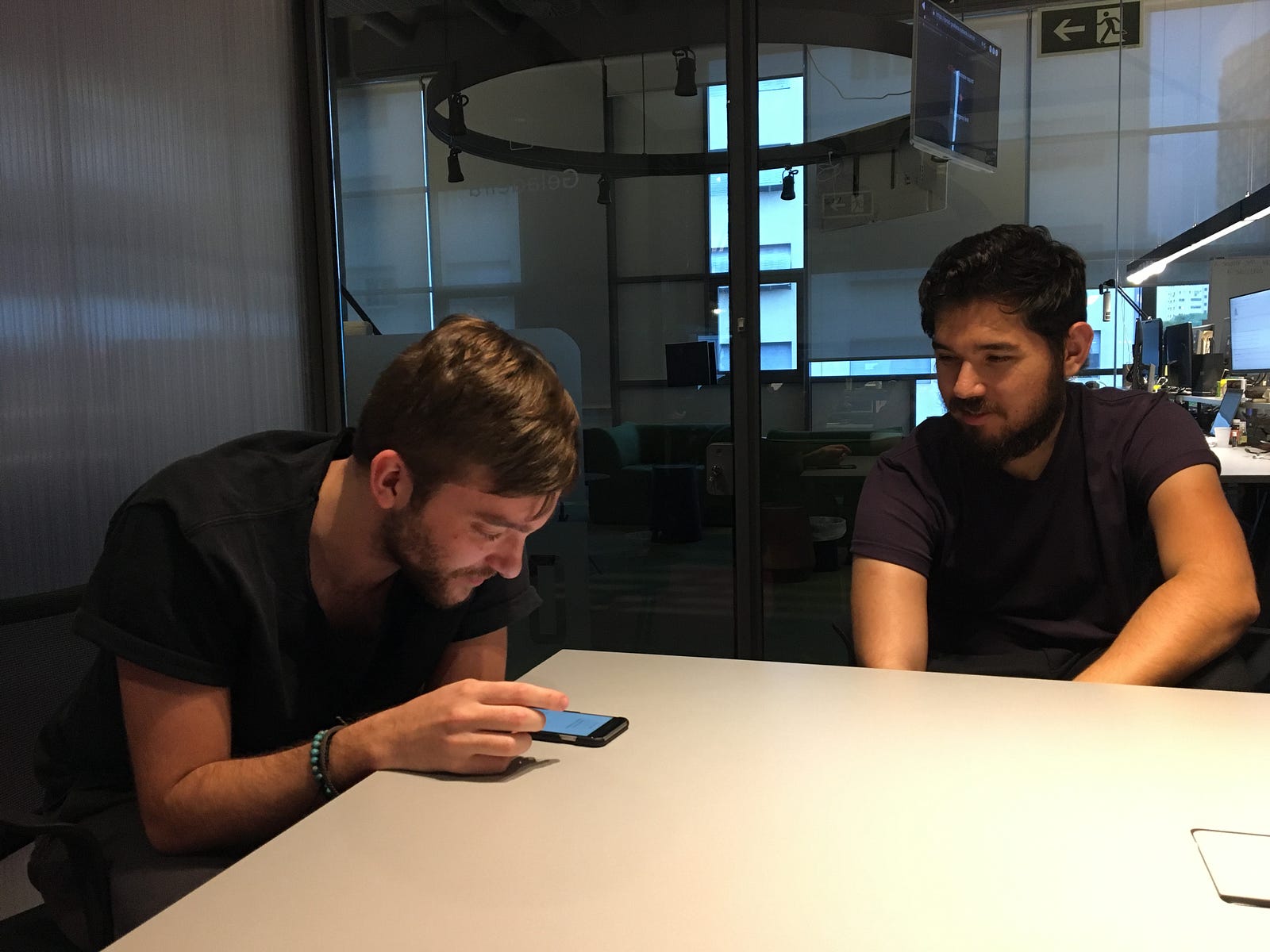
Also, in the beginning, we had a lot of trouble booking space for research sessions: There was never a room available for long enough, which made us run around and re-setup with gear in between sessions; and business meeting rooms are not especially suited for making people comfortable talking about their lives. To account for that, we’ve built a room in our design corner of the building exclusively for research use. It’s now called Engelbart, (in honor of one of the founding fathers of human–computer interaction), and we’ve replaced tables and office chairs with a sofa, TV rack, snacks, and plants to make people feel more relaxed.
2. Engaging and transparent
Writing polished reports or presentations about our research findings turned out to have very little value to us. We tried sharing PDFs on Slack, putting insight posters up on walls, and still got no sense that people were finding the information useful. Also, having stakeholders be in touch only with the end results often felt frustrating, as it was easy for them to dismiss findings based on personal opinions or biases.
So what we decided to do was to make all the action live. Now, all our research sessions are streamed to a second room where everyone interested is invited to watch, and there are no final reports or presentations to be shared. This move was by far the most valuable of all for us, as it puts product managers, engineers, and other professionals in direct contact with the user they’re working for, helping develop empathy both for the customer and for the design team, making our processes less obscure to professionals with more analytical and rational backgrounds.
Quick note about how we actually do this: we didn’t want a two-way-mirror setup, since we think it’s too obvious and make people very uncomfortable. Our best solution was to plug cameras and microphones to a physical HDMI cable that goes up to a watching room, streaming all video and audio perfectly. We tried streaming through the internet but the quality was never perfect. Also, with streaming stakeholders started watching sessions from their desks, which does not enable for collaborative note-taking and live discussions with others.
3. Well documented
I mentioned that we didn’t do many reports and presentations on UX research anymore, and it’s true: the beauty of having stakeholders all together watching the session is that they can do the parsing and documentation themselves, while the interview is still happening. Furthermore, with more people involved in taking and comparing notes, we reduce bias in the final conclusions, insights, and action points. (see this article on Collaborative User Testing).
We give everyone access to a fresh copy of Jessica Crabb’s incredible Trello Board and instruct them to collectively participate on the sorting of quotes, insights, and action points in real time. This board is great since it helps keep all the documentation (screeners, participant list, interview guide, questionnaires, NDAs, prototypes, raw notes, insights, and action points) in one centralized place.
As a backup, in case something goes wrong with the tech setup or in case there’s no one watching the sessions, we always have a second person in the interviewing room taking their own notes. At the end, we upload all testing videos to a private Youtube channel so people can check back on them if necessary.